
Nowadays, the vast majority of legal or administrative procedures can be carried out online. However, in order to verify your identity online and formalize any legal process effectively, you need a digital certificate. In this article we will show you exactly what this digital ID is and why you need one, and we will see how to obtain yours step by step without leaving your home.
Key takeaways
- What it is: your online identification document: it verifies your identity and lets you sign documents with one click when you deal with the administration over the internet.
- What it’s for: registering as self-employed, filing tax returns and handling residence permit paperwork online, so you avoid appointments, queues and long waits at administration offices.
- Which to choose: the citizen certificate if you are an individual or freelancer, free for anyone of legal age with a DNI or NIE; company administrators choose the company certificate.
- What you need: the latest version of Firefox, Chrome, Edge, Opera or Safari and the FNMT-RCM configurator, which you download from the FNMT e-office.
- How to get it: request it at the FNMT e-office, receive a code by email, verify your identity by video, in person or with your DNIe, and download it with that code.
- Validity: the FNMT citizen certificate lasts 4 years, although those issued in 2026 expire on 31 December 2028; the representative certificate lasts 2 years.
What is a digital certificate in Spain?
On a general level, the digital certificate is just your online identification document that will allow you to carry out procedures with the administration over the Internet.
The traditional way of formalizing any kind of official paperwork is simple. You went to the corresponding office, filled in the specific document and signed it, and afterwards the clerk asked for your ID card or passport to verify your identity.
But what happens if you do the paperwork online?
As you cannot present your ID, the digital certificate is created to verify your identity and automatically sign any type of document with just one click.
Why do you need a digital certificate?
Going to any government administration office to do your paperwork is now a thing of the past.
Currently, the vast majority of procedures can be carried out online, whether regarding immigration, taxes, business or any other administrative issue.
For example, it is possible to register as a self-employed worker, submit your quarterly/annual tax returns, or carry out procedures related to your residence permit, all online without leaving home.
But to enjoy that easiness you’ll need a digital certificate.
So, if you don’t have it yet, we strongly recommend that you apply for one.
It will save you a lot of time and facilitate many administrative procedures. If you want to avoid losing a whole morning because you need to request an appointment, queue up, wait, and wait… (and we all know how slow the Spanish administration can be). You need a digital certificate.
Besides, as we will see below, applying for it is very simple!
Types
According to the regulations, a distinction is first made between two basic categories:
- Electronic certificate (simple): a document signed by a certification service provider, linked to signature verification data, that confirms the signer’s identity.
- Recognised or qualified electronic certificate: a certificate that meets a series of additional, stricter conditions, both in terms of content and the provider’s requirements.
And, depending on the holder or use, the main types issued in Spain (by the FNMT and other certification service providers) are:
- Certificate for Natural Persons (Citizens), for individuals. It allows you to identify yourself online and exchange information with other people and organisations, with the guarantee that only you and the other party can access it. Any Spanish or foreign citizen, of legal age or an emancipated minor with a DNI or NIE, can apply for it free of charge.
- Certificate for a Representative of a Legal Entity: issued to individuals acting as representatives of legal entities to handle administrative procedures with government agencies.
- Certificate of Representative for Sole or Joint Administrator: legal entities, through their legal representatives, carry out procedures with government agencies and contract goods or services related to their regular business operations. Applicable only if the administrator is properly registered in the Commercial Registry.
- Certificate of Representative of an Entity Without Legal Personality: issued to individuals acting as representatives of entities without legal personality (communities of property, undistributed estates, etc.) for tax purposes.
- Public Employee Certificate and Administrative Body Seal / Electronic Headquarters Certificate, for use within the public administration.
- Device/System Certificates: increasingly important in industrial, healthcare and logistics environments for sensors and automated systems that generate data requiring digital signatures to be valid as evidence.
How to get a digital certificate in Spain
Let’s now take a look at the step-by-step process to get your digital certificate online.
1. Select your browser
This introductory step is crucial and very important.
You can only request the digital certificate with the latest versions of:
- Mozilla Firefox
- Google Chrome
- Microsoft Edge
- Opera
- Safari
If you don’t have any of them installed, that’s the first step to take.
Moreover, you’ll need to install the FNMT-RCM configurator, available on the official website of the Fábrica Nacional de Moneda y Timbre. You can do so using this link, and it will only run if you use one of the browsers we listed above: prior configuration (FNMT e-office).
2. Enter the FNMT website
This is where you’ll do all the paperwork.
First of all, access the portal of the “Fábrica Nacional de Moneda y Timbre”, by clicking here.
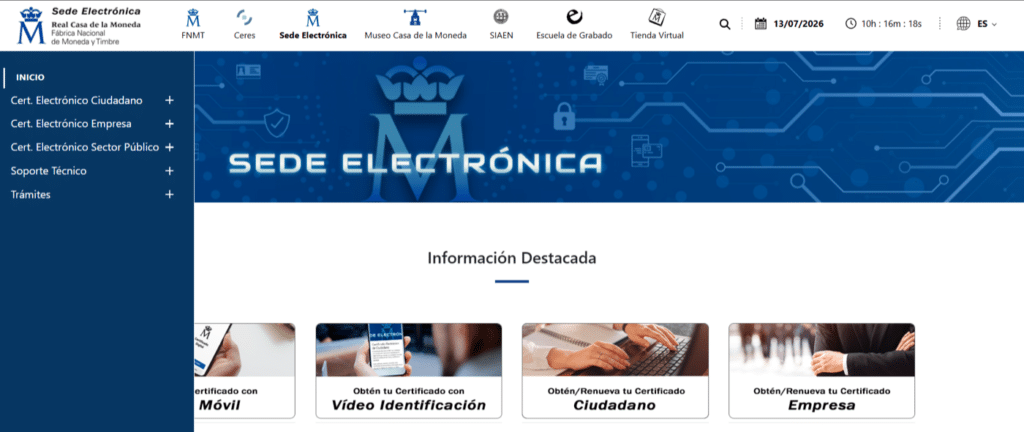
In the sidebar tab, which is already open, select the digital certificate you need based on your situation (we’ve explained them above).
3. Select the type of certificate you want to apply for
As you can see, there are different options.
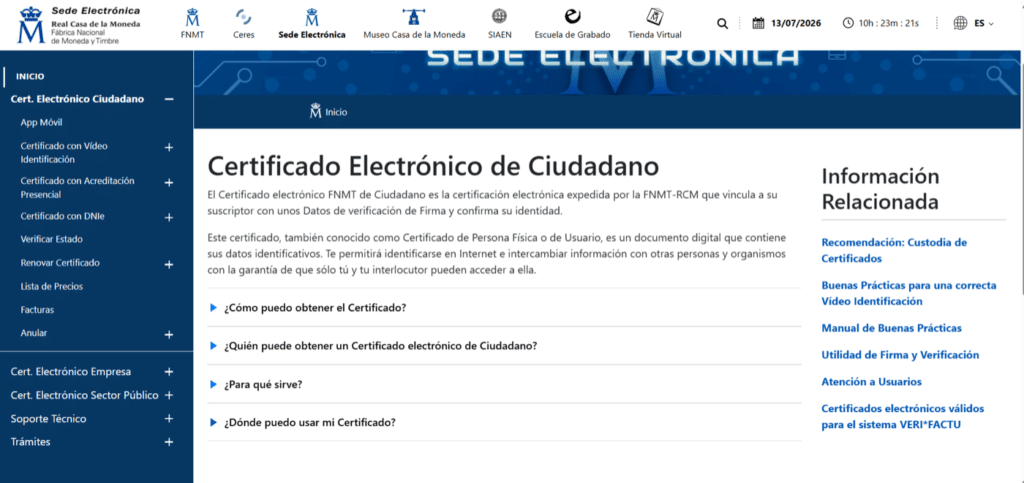
Generally, you will mark the option “Certificado electrónico del ciudadano” (natural person), if you are a private individual or freelancer. This would be the most common situation.
Only in cases where you are a company administrator would you check the “Certificado electrónico de empresa” option.
If you are a public sector worker, you should choose the “Certificado electrónico del Sector Público”.
4. Obtain the certificate
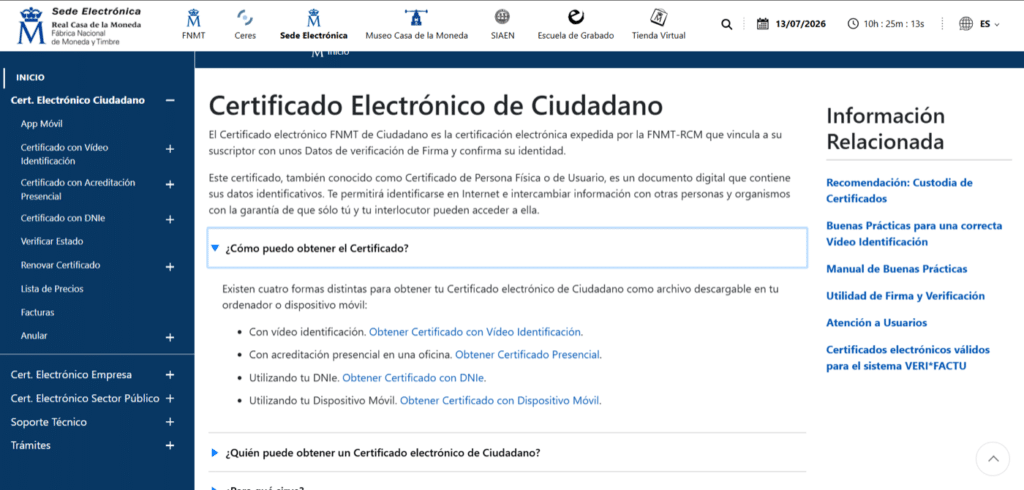
To proceed, you must click on the desired certificate. Then you’ll need to click on the first drop-down menu, “¿Cómo puedo obtener el certificado?”. There, you’ll see all the options available to you for obtaining your digital certificate.
Obtain the certificate with any of the first three options
For the first three options (obtaining the certificate by video identification, in person or with the DNIe), the steps are common to all of them, except for the way you verify your identity. These steps are:
- Install the software: as we indicated above, you’ll need to use one of the browsers that enable you to obtain your certificate and download the necessary software to proceed.
- Request your certificate. You must do it through the following link (it will work as long as you are in the right browser with the software installed): request certificate (FNMT e-office).
This is the page that should open:
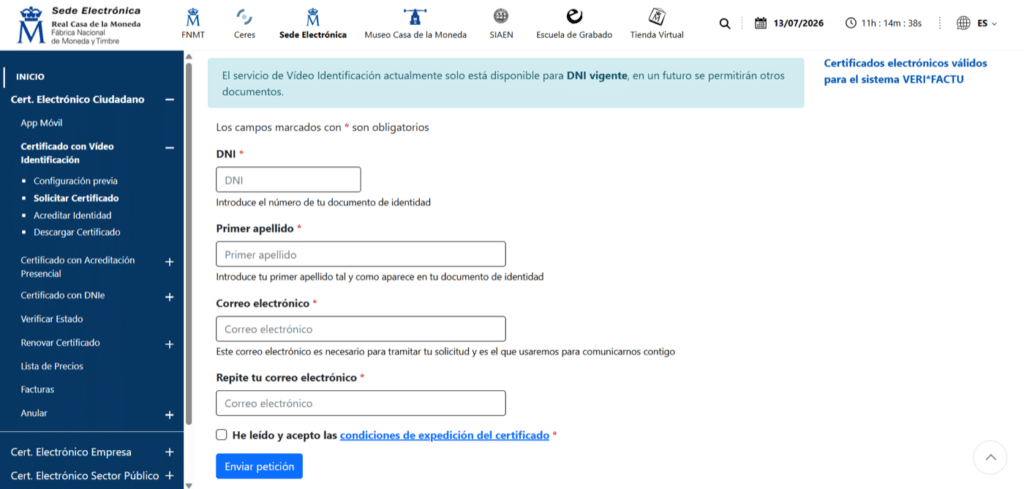
The ID number you enter must be valid at that time; no other document will be accepted.
After submitting the request, you will receive an email with a request code, which is very important for proceeding with the application. This code is required to download your certificate.
- Verify your identity:
This step varies depending on the option you have chosen:
- Video identification: you’ll need to scan the QR code that appears on the screen using your mobile phone. A valid electronic ID card is required. Within 48 business hours, your identification video will be reviewed, and you’ll receive an email approving or rejecting it. The video identification service costs 2.99 euros plus taxes, although the certificate itself is free. If your video identification is approved, you can use your application code to download and install your certificate and make a backup copy.
- In-person verification: you must verify your identity at one of the identity verification offices, that is, at AEAT offices, Social Security offices and other offices. Please note that an appointment is required; you’ll need to check the website of each respective office. You can use the office locator. One hour after you’ve verified your identity, you’ll be able to download and install your certificate with your application code and make a backup copy.
- With a DNIe: after filling out your certificate application, it will take one hour to receive your application code, which you’ll use to download your digital certificate.
I have the application code; what do I do with it now? How do I download the certificate in the final step?
Regardless of which of the three methods you used, you’ll need your application code to download your certificate. But how do you do that? Well, this is the easiest step.
Go to the following link: download certificate (FNMT e-office).
This link will take you to the following screen:
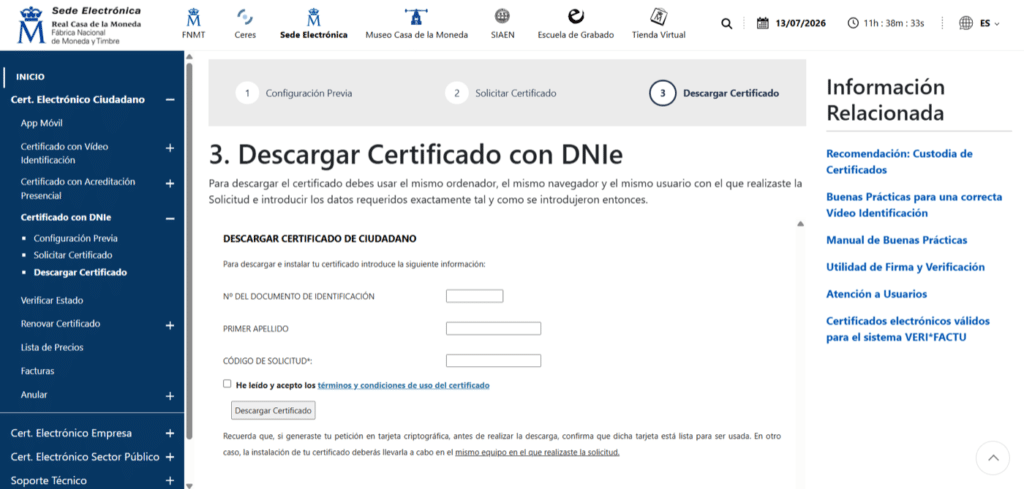
Fill it out with your information:
- Your ID number
- Your last name
- Your application code
And finally, download your certificate.
Get the certificate using a mobile device
This isn’t really a “fourth option”, but rather a way to complete any of the other options more conveniently from your own phone.
First, you’ll need to install the app on your phone:
- App Store: Certificado digital FNMT
- Google Play: Certificado digital FNMT
Once installed, you’ll need to request your certificate through the app to obtain your request code.
Once that’s done, all you have to do is choose within the app how you’ll verify your identity; you can use any of the methods we’ve explained above.
Once your identity has been verified, you’ll be able to download the certificate directly from the app.
Procedures you can carry out with it
More specifically, this certificate will allow you to communicate and carry out online procedures with:
- The Tax Office, for example by uploading your tax returns or reviewing the income tax returns of previous years.
- Social Security, so you can see from your computer how many years you have left before you can retire or request your work-life report.
- The Court and justice system, to file appeals.
- Bank of Spain.
- Immigration offices, so that you can, for example, make an appointment to submit your visa application, pay fees online, or provide any missing documents.
- Other procedures such as consulting fines, verifying the registration in the census, etc.
Validity of the certificate
The validity period of a digital certificate depends on the issuing authority and the type of certificate:
| Certificate | Validity |
|---|---|
| FNMT: Individuals and Digital Seals | 4 yearsCertificates issued during 2026 expire on 31 December 2028 due to security updates; the 4-year validity period will resume from 1 January 2027. |
| FNMT: Representative Certificate | 2 years |
| Electronic ID card (DNIe) | 30 months maximumApproximately 2 and a half years. |
In general, Law 6/2020 stipulates that the validity period of recognised certificates may not exceed five years.
You can check the validity of your certificate here: check status (FNMT e-office).
Get assistance to apply for the certificate as a foreigner
Do you need help? Our team of lawyers will help you request your digital certificate quickly.
In addition, we can use it to handle any legal proceedings with the administration for you, so it will be very useful to have a team of specialized legal advisors.
Choose the date that suits you best for a consultation with our lawyers, and let us guide you step by step.
Related content of interest:
- How to open a bank account in Spain
- Digital Nomad Visa in Spain
- Work remotely from Spain
- Residence permit in Spain

At Balcells Group we have been foreigners effortlessly moving to Spain for over 11 years. We help expats from all around the world with their immigration, business, tax and legal needs; ensuring a legally safe and enjoyable transition to the Spanish territory. Our multilingual team understands the importance of adapting to the cultural and legal specificities of our international clients. We offer a comprehensive service that combines the expertise of several generations of lawyers with the innovation needed to address today’s legal challenges, always striving to simplify processes and ensure reliable, effective results.